
Most people feel anxious from time to time. Before a job interview. While waiting for test results. When something important is uncertain.
That kind of anxiety is normal. It is your survival system doing its job, flagging a possible risk and nudging you to pay attention.
But for some people, anxiety stops being occasional and starts becoming the backdrop to everything. It moves in. It gets louder. And over time, it begins to shape how you think, how you feel in your body, and how you move through your day.
This post is a plain language look at what anxiety actually is, how it shows up, and how to tell when it may have moved beyond the everyday and into something that deserves support.
There are a lot of clinical definitions out there. Here is a simpler way to think about it.
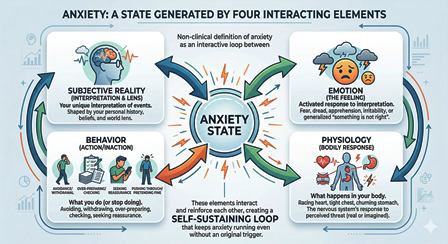
Anxiety is a self-reinforcing state shaped by how you interpret your world, what you feel emotionally, what happens in your body, and what you do in response.
Let's break that down.
Subjective reality is the way you interpret and make sense of what is happening around you. Two people can be in the same situation and experience it very differently. Your personal history, your beliefs, and the lens you see the world through all shape how a situation lands for you.
Emotion is what gets activated in response to that interpretation — fear, dread, apprehension, irritability, or a vague sense that something is not right.
Physiology is what happens in your body — the racing heart, the tight chest, the churning stomach, the restlessness. Your nervous system responds to perceived threat whether the threat is real or imagined.
Behaviour is what you do (or stop doing) as a result — avoiding, withdrawing, over-preparing, checking, seeking reassurance, or pushing through while pretending everything is fine.
These four elements do not just sit side by side. They interact. They reinforce each other. And when they get locked into a pattern, anxiety can become self-sustaining — a loop that keeps running even when the original trigger has passed.
It starts with worry.
Worry is your mind's risk identification process. Your brain scans incoming information for danger, uncertainty, ambiguity, change, and novelty, anything where the outcome is not yet known.
Your mind flags these situations as potential risks, and anxiety is the signal that draws your attention to them. This is useful. It is part of your survival operating system. It helps you prepare, plan, and protect yourself. The difficulty comes when worry becomes problematic. When your mind keeps scanning and flagging risks:
When worry becomes hard to control, the anxiety it generates can start to feel constant.
If you find yourself caught in cycles of worry that are hard to switch off, you might find the Problematic Worry Support page helpful.
Anxiety is not just a thought. It is a whole-body experience. A feeling is made up of physical sensations and one or more emotions, and anxiety tends to involve both in full force.
Physical sensations of anxiety
Emotions that often accompany anxiety
When anxiety takes hold, your thinking changes too.
You may find it harder to focus or concentrate. Your mind may jump between worries or get stuck replaying the same scenario over and over. Decision-making can feel harder than it should. And you may start worrying about the anxiety itself — dreading the next wave, the next panic attack, the next moment where it all feels too much.
This is one of the ways anxiety sustains itself. The worry about feeling anxious creates more anxiety, which creates more worry. It becomes a loop.
Anxiety does not just live in your mind and body. It changes what you do.
Avoidance. If your mind predicts that a situation will go badly, you will naturally want to avoid it. Over time, avoidance can shrink your world — fewer social situations, fewer opportunities, fewer moments where life feels open and possible.
Safety behaviours. These are things you do to try and prevent a feared outcome or to feel more comfortable in situations that make you anxious. A simple test: ask yourself, "How anxious would I feel if I could not do this?" If the answer is "very," it is probably a safety behaviour. These behaviours reduce anxiety in the short term, but they tend to keep it going in the longer term.
Panic attacks. For some people, anxiety spikes into full-blown panic — a sudden, intense surge of physical and emotional overwhelm that can feel frightening and disorienting. If panic has become part of your experience, the Panic Support page may be worth a look.
Not everyone experiences anxiety in the same way. Two terms that are increasingly used — though they are not formal clinical diagnoses — are high-functioning anxiety and low-functioning anxiety. They describe different patterns in how anxiety shows up in daily life.
This is the kind of anxiety that hides in plain sight. From the outside, you may look capable, reliable, and on top of things. You meet deadlines. You show up. You keep everything moving.
But underneath, your mind may be racing constantly. You may be over-preparing, overthinking, second-guessing, and finding it hard to switch off. Perfectionism, mental load, and a constant sense of inner pressure are common features.
People with high-functioning anxiety often do not realise how much energy they are spending just to appear "fine."
If this sounds familiar, the High-Functioning Anxiety Support page goes into more detail about this pattern and how coaching and clinical hypnotherapy can help.
Low-functioning anxiety is what can happen when the system has been under strain for too long. Anxiety becomes so intense or persistent that it starts to interfere with your ability to manage everyday life.
Rather than pushing through, you may find yourself withdrawing, avoiding, struggling to get started on even simple tasks, or spending long stretches feeling stuck or shut down. Getting out of bed, leaving the house, or making a phone call may feel overwhelming.
This does not mean you are weak. It often means your nervous system has been in overdrive for so long that it has shifted into a kind of protective shutdown.
If this resonates, the Low-Functioning Anxiety Support page explains how one-to-one coaching and clinical hypnotherapy support can offer a calm, manageable starting point.
It is worth saying that these are not fixed categories. Some people move between the two depending on what is happening in their life. You might function well at work but shut down at home. You might push through for weeks and then hit a wall. The labels are less important than recognising that anxiety is affecting your life and that support is available.
If you experience one or more of the following on a regular basis, your anxiety may have moved beyond the everyday:
None of these things on their own mean something is "wrong" with you. But if anxiety has started to shape your decisions, your confidence, or the way you live your day-to-day life, it may be worth exploring support.
If anxiety has become a regular part of your experience, there are a few things worth considering.
Talk to someone you trust. Whether that is a friend, a family member, or a professional — putting words to what you have been experiencing can be a helpful first step.
See your GP. If your anxiety is persistent or severe, your doctor can help you understand what is going on and discuss your options. This is especially important if anxiety is affecting your sleep, your ability to work, or your physical health.
Consider professional support. There are different kinds of support available depending on where you are and what you need. Coaching and clinical hypnotherapy, for example, can help you understand your anxiety pattern and begin changing the way your system responds — working with the interaction between your subjective reality, emotions, physiology, and behaviour rather than just trying to manage symptoms on the surface.
If you are curious about what that looks like in practice, The Nervous System Coaching Program offers one-to-one support for adults experiencing worry, high-functioning anxiety, low-functioning anxiety, chronic stress, phobias, and panic. The first step is a 30-minute consultation to talk things through and see whether it feels like the right fit.
Anxiety is not a character flaw. It is not a sign that you are broken or that you are not coping well enough. It is your system responding to what it perceives as risk — and sometimes that system gets stuck in a pattern that no longer serves you.
Understanding what anxiety actually is, how it works, how it shows up, and how it sustains itself, is a genuinely useful starting point. Not because knowledge alone fixes things, but because it gives you a clearer picture of what you are dealing with and what kind of support might help.
If you have been carrying anxiety for a while, you do not have to keep managing it alone.
Tony Yuile is a Wellington-based Life Coach and Clinical Hypnotherapist who works one-to-one with adults experiencing worry, high-functioning anxiety, low-functioning anxiety, chronic stress, phobias, and panic. Sessions are available via Zoom for adults in New Zealand and internationally.
Important Information: This blog post is for general informational purposes only. It does not constitute medical advice, diagnosis, or treatment. If you are experiencing persistent anxiety or have concerns about your mental health, please consult your registered health practitioner. If you are experiencing a mental health crisis or have urgent concerns about your safety, contact your GP or local emergency services immediately.
