

Do you dread the idea of having a panic attack in a crowded meeting, on a bus, or mid-flight? Maybe you've started avoiding enclosed spaces altogether — not because of the space itself, but because of what might happen inside it.
If that sounds familiar, you're not alone. Panic attacks often come out of the blue and can be terrifying. But once you understand what’s actually happening in your body and brain, everything starts to make more sense — and change becomes possible.
A panic attack is a sudden surge of intense fear or discomfort that usually peaks within minutes ( between 3-10 minutes). The typical physical symptoms of a panic attack are:
• Racing heart
• Shortness of breath
• Chest tightness
• Dizziness or light-headedness
• A sense of losing control or feeling trapped
Although these sensations feel dangerous, they are not. A panic attack is your body's survival system activating at the wrong time — a false alarm.
Your brain is acting as though you're in real danger, even when you’re not.
It’s trying to save you NOT kill you!
Once you've had a panic attack in a particular situation — a packed meeting room, a flight, or a stressful day at work — your brain learns to associate that situation with threat.
This creates what we call the panic loop:
Trigger → Physical Sensations → Scary Thoughts → More Fear → More Sensations → Panic
Here’s the twist: it’s not the situation itself that causes the panic — it’s the fear of the panic returning that fuels it. This is known as anticipatory anxiety: the fear of fear.
Over time, this leads to avoidance behaviours. You might start steering clear of small rooms, public transport, planes, or even certain work situations — not because you can’t cope, but because you’re scared of panicking again.
Your brain’s amygdala — the part responsible for detecting danger — is very good at learning from emotionally intense experiences. If a panic attack happened on a plane, in a meeting, or on a bus, the brain starts to flag similar situations as unsafe.
This means your nervous system may start reacting before you even enter the space — even if you know rationally there's no real threat.
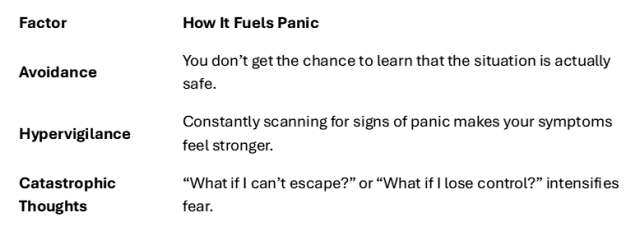
Several factors contribute to the persistence of panic attacks:
Imagine a smoke alarm that goes off every time you make toast. It’s not broken — it’s just oversensitive. Your body is doing the same thing: reacting as if there’s danger when there’s no threat at all.
This fear–panic–avoidance cycle is learned — and that means it can be unlearned. You are not stuck.
Using a combination of evidence-based techniques, you can retrain your brain to stop seeing enclosed spaces as dangerous and help your body stay calm under pressure.
These include:
If you’re living with panic and avoidance, it’s not because you’re weak. It’s because your brain has been doing its job a little too well.
But that’s not the end of the story.
With the right approach, you can break the fear of fear, regain confidence in your body, and return to the situations you’ve been avoiding — without panic holding you back.
If you're ready to take back control, I offer integrative sessions using proven approaches like hypnotherapy, Havening, and IEMT. Many clients experience significant relief in just a few sessions.
Take the first step to freedom today - book a no-obligation 30-minute discovery session and let’s map out a plan that works for you.
You don’t have to avoid life to avoid panic. Let’s find your calm again.

Tony Yuile is a Wellington-based Life Coach and Clinical Hypnotherapist dedicated to helping individuals navigate the complexities of anxiety and stress. Tony’s mission is driven by the belief that everyone deserves to feel in control of their own mental well-being. He specialises in providing practical, mind-based tools that empower his clients to manage anxiety and stress effectively and rediscover a sense of calm and confidence in their daily lives.