During the day, you managed. You were busy. You had things to focus on, conversations to have, tasks to get through. The worry was there, running in the background, but you could keep it at arm's length.
Then the day ends.
The lights go down.
The house goes quiet.
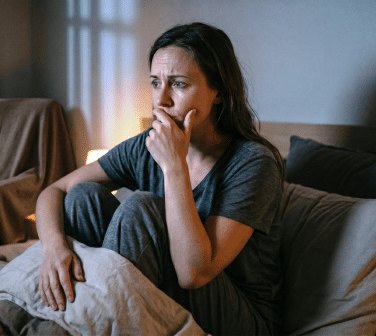
You get into bed.
And your mind starts generating worry thoughts - cycling through risks - the 'what ifs' and the uncertainties: The email you forgot to send. The doctor's appointment next week. The unexpected bill for boiler repairs. The bigger, shapeless worry underneath all of it that you cannot quite name.
Your survival system responds to this cascade of identified risks. Your body, which should be winding down, does the opposite. Your chest tightens. Your jaw clenches. Your legs feel restless. You are tired, genuinely tired, but every part of you is humming with a low-level alertness that will not switch off.
If this happens to you regularly, you are not imagining it. This is the reason anxiety gets more intense at night. And understanding it is the first step toward it changing.
During the day, most people have enough external input to keep their attention occupied. Work, responsibilities, conversations, movement, noise. These do not make worry go away. But they give your mind something else to focus on, which means the worry gets less airtime.
This is not a coping strategy you have consciously chosen. It is something that happens automatically. Your brain can only attend to so much at once, and when the external environment is demanding enough, the worry thoughts get pushed to the edges of awareness.
But at night, the external input drops away. There is nothing competing for your attention. And the worry thoughts that were running in the background all day, suddenly have the stage to themselves.
It is not that anxiety gets louder at night. It is that the worry has been running all day without resolution — and at night, with nothing competing for your attention, the anxiety it generates can finally be felt in full.
Here is the part that makes nighttime anxiety feel so maddening.
You know it is time to rest. You have done everything you need to do. There is nothing you can act on right now. Logically, there is no reason to be on alert.
But your nervous system does not operate on logic. It operates on prediction.
As I described in an earlier post, your brain is constantly generating predictions about what is coming next, based on past experience. If your system has learned that the world requires vigilance, that you need to stay prepared, that letting your guard down is when things go wrong, it will keep running its risk identification process regardless of what time it is.
Your conscious mind says, "it is safe to rest." Your nervous system says, "I have not finished checking for potential threats (risks)."
And because the nervous system's responses are faster and more powerful than conscious thought, the body stays in a state of alert even as the mind is trying to wind down. Heart rate stays elevated. Muscles stay tense. Breathing stays shallow. The conditions for sleep are not met, because your system is still running as though it needs to be ready for something.
There is another layer to this that is worth understanding.
During the day, you are moving. Your body is active, and the physical sensations of anxiety, the tight chest, the restless legs, the churning stomach, can be harder to notice because they blend into the general background of being physically engaged.
At night, when you lie still, those sensations become much more noticeable. And here is where the worry loop kicks in.
Your brain is always monitoring your body state, using it as one of the inputs for its predictions about whether things are safe or threatening. When you lie in bed and become aware of a racing heart or a tight chest, your brain interprets those sensations as evidence that something is wrong. It does not say "that is just residual tension from the day." It says, "the body is on alert, there must be a reason."
That interpretation triggers more what-if thinking. More risk identification. Which generates more anxiety. Which shows up as more physical tension. Which your brain interprets as more evidence of threat.
The worry loop that was manageable during the day, when external distractions were breaking the cycle, now runs uninterrupted. Your body and your mind amplify each other in the silence.
You may have tried the standard advice. No screens before bed. Herbal tea. Breathing exercises. A calming playlist.
These are not bad suggestions. They can help create conditions that are more favourable for rest. But if your nervous system is genuinely locked into a state of alert, a surface-level routine is unlikely to override it.
It is a bit like trying to calm a smoke alarm by opening a window. The gesture is reasonable, but it does not address the thing that set the alarm off in the first place.
The system is not staying alert because you looked at your phone too late. It is staying alert because somewhere underneath, your predictive brain has concluded that it is not safe to stand down. Until that deeper assessment shifts, the alertness continues, regardless of how many candles you light.
If nighttime anxiety is a pattern for you, it is worth considering what it is telling you about your daytime state.
Because the anxiety at night is not a separate problem. It is the product of the same worry that was running all day, finally making itself fully known. The busyness was masking it, not managing it. And the body state you notice when you lie down, the tension, the alertness, the inability to settle, has probably been building for hours.
This is especially common in high-functioning anxiety, where the daytime performance looks polished, but the internal cost is high. It is also common in chronic stress, where the system has been running in a sustained state of alert for so long that it has lost the ability to downregulate, even when the circumstances allow it.
In both cases, the nighttime experience is not the root issue. It is the consequence of a system that never truly settled during the day.
In my one-to-one work with clients, I approach nighttime anxiety not as a sleep problem but as a nervous system problem.
Nervous System Coaching helps you look at the daytime patterns that are feeding the nighttime experience. What is keeping your system in alert mode throughout the day? Where are the demands, the ongoing worry, the safety behaviours, the pressure that your system never gets a break from? And what small, realistic shifts might begin to change the load your nervous system is carrying by the time you reach the pillow?
Clinical hypnotherapy works with the nervous system's ability to settle. When a system has been locked in alert mode for a long time, it can lose its capacity to come down, even when the environment is safe. Hypnotherapy supports that recalibration directly, helping the nervous system learn that it is safe to stand down, safe to rest, safe to let the worry go.
The two together address both what is maintaining the pattern and the nervous system state that is driving it. The goal is not just a better night's sleep. It is a system that no longer needs to stay on guard around the clock.
If nighttime anxiety has become part of your routine and you would like to talk through what has been going on, a 30-minute consultation with me, is a simple place to start. Sometimes the most useful moment to seek support is when you realise the worry pattern is not going away on its own.
The consultation is a calm, no-pressure conversation about your situation, your experience, and whether the Nervous System Coaching Program feels right for you. No preparation needed. No decision required on the day.
The consultation is available via Zoom, so you can do it from home, at a time that works. There is a fee of NZ$49 for the consultation. This is deducted from the price of the Program if you decide to invest in it.
This is the third post in an ongoing series exploring the specific ways anxiety shows up in daily life. The next post in the series explores why anxiety leaves you exhausted even when you did nothing.
Important Information: This blog post is for general informational purposes only. It does not constitute medical advice, diagnosis, or treatment. If you are experiencing persistent anxiety or have concerns about your mental health, please consult your registered health practitioner. If you are experiencing a mental health crisis or have urgent concerns about your safety, contact your GP or local emergency services immediately.

Tony Yuile is a Wellington-based Life Coach and Clinical Hypnotherapist dedicated to helping individuals navigate the complexities of anxiety and stress. Tony’s mission is driven by the belief that everyone deserves to feel in control of their own mental well-being. He specialises in providing practical, mind-based tools that empower his clients to manage anxiety and stress effectively and rediscover a sense of calm and confidence in their daily lives.