
Your predictive brain. The third in this series of posts. Read the previous post here.
You are sitting at your desk. Your phone buzzes. Before you have even looked at the screen, your stomach drops.
Or you are walking into a social event. You have not spoken to anyone yet. Nothing has gone wrong. But your chest is already tight, your breathing has shifted, and a low hum of dread has settled over you.
Or you wake at 3am. No nightmare. No noise. But your heart is pounding and your mind is already racing through everything that could go wrong tomorrow.
If you experience anxiety, moments like these are probably familiar. The feeling arrives before the reason does. Your body is already reacting to something your conscious mind has not yet identified and sometimes cannot identify at all.
This is not a malfunction. It is your brain doing exactly what it was built to do.
Here is something that might change how you think about anxiety.
Your brain does not simply wait for things to happen and then respond. It is constantly predicting what is about to happen and preparing your body in advance.
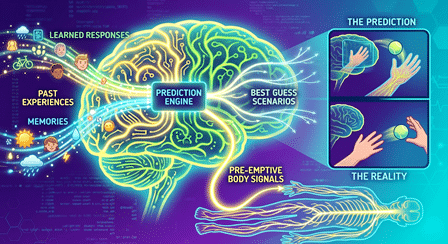
Your predictive brain: every moment of every day, your brain is drawing on everything it has learned from your past experiences, your memories, your environment, and the current state of your body to generate a best guess about what is coming next. It then sends signals to your body to get ready, before the event has actually occurred.
This is incredibly useful most of the time. It is how you catch a ball without consciously calculating its trajectory. It is how you finish someone's sentence before they have said the last word. It is how you navigate a familiar drive home while your mind is somewhere else entirely.
Your brain is not reacting to the present. It is running a model of the present based on the past and preparing you for what it expects to happen next.
In anxiety, this prediction system develops a bias. It starts over-predicting threat.
Your brain has learned, through difficult experiences, prolonged exposure to stressors, or environments where things felt unpredictable or unsafe, that certain kinds of situations are dangerous. Not dangerous in the way a charging animal is dangerous. Dangerous in the way that matters to a human being: rejection, humiliation, failure, loss of control, being caught off guard, not being good enough.
Once those predictions are in place, your brain does not wait for evidence. It generates the threat response automatically based on pattern recognition. A social situation that echoes a past humiliation. A moment of uncertainty that resembles a time when things fell apart. A tone of voice, a silence, a sensation in your body that your system has learned to associate with something going wrong.
The prediction fires. Your nervous system responds. Your body shifts into a state of alert, heart rate up, muscles tense, breathing shallow, stomach tight. And all of this happens before your conscious mind has even begun to assess the situation.
By the time you notice you are anxious, your system has already decided there is a threat. The conscious thoughts that follow, the "what ifs," the worst-case scenarios, the urge to avoid, are not the cause. They are your mind's attempt to make sense of a state your body is already in.
If you have ever felt anxious in a situation you know is safe, this is probably why.
Your conscious mind is looking at the evidence and concluding there is no real danger. But your predictive survival system is not using conscious evidence. It is using pattern recognition drawn from years of experience, much of it stored in your body and your nervous system rather than in your conscious memory.
These two systems can reach completely different conclusions at the same time. Your thinking mind says: "this is fine." Your body says: "this is not safe." And because the body's response is faster, louder, and more physically overwhelming, it usually wins.
This is not weakness. It is not irrationality. It is a mismatch between two processes that are operating on different timescales and using different kinds of information. Your survival system is doing what it was designed to do, it is just working with outdated predictions.
If your brain is making predictions based on past experience, you might expect it to update those predictions when new experience proves them wrong. And sometimes it does. But in anxiety, several things can prevent that update from happening.
Avoidance. If you avoid the situations your system predicts are threatening, your brain never gets the chance to learn that the prediction was wrong. The threat remains unresolved. The prediction stays active.
Safety behaviours. If you do enter the situation but rely on coping strategies to get through, checking your phone, rehearsing what to say, staying near the exit, keeping quiet, your brain attributes your survival to the behaviour, not to the situation being safe. The prediction stays active.
The body state itself. When you enter a situation already feeling tense, your brain uses that physical state as evidence that something is wrong. Your body's anxiety becomes proof of the threat, which generates more anxiety, which reinforces the prediction. The loop sustains itself.
This is one of the reasons why anxiety can feel so unchangeable. It is not that you are not trying hard enough to think differently. It is that the prediction system operates largely outside of conscious control, and the very strategies you use to cope can accidentally keep it running.
This is the question that matters most if you are living with anxiety that has been running for a long time.
If the predictions are stored in your nervous system and operate before conscious thought, then working with conscious thought alone is unlikely to be enough. You need ways to reach the system where the predictions are actually held.
That is the foundation of how I work with clients. Coaching creates space to identify the patterns, the avoidance, the safety behaviours, the cycles that are keeping the predictions locked in place. It brings awareness to what is happening and begins to open up different ways of responding.
Clinical hypnotherapy goes a step further. It works with the nervous system more directly, helping to settle the threat response, update the patterns that are driving the predictions, and support change at a level that your conscious mind may not be able to reach on its own.
It is not about overriding your survival system. It is about helping your predictive brain recalibrate, so that it can start making predictions based on where you are now, rather than where you have been.
The next and final post in this series looks at how coaching and clinical hypnotherapy work together in practice and why having two entry points into the same system is more effective than relying on one alone.
Important Information: This blog post is for general informational purposes only. It does not constitute medical advice, diagnosis, or treatment. If you are experiencing persistent anxiety or have concerns about your mental health, please consult your registered health practitioner. If you are experiencing a mental health crisis or have urgent concerns about your safety, contact your GP or local emergency services immediately.

Tony Yuile is a Wellington-based Life Coach and Clinical Hypnotherapist dedicated to helping individuals navigate the complexities of anxiety and stress. Tony’s mission is driven by the belief that everyone deserves to feel in control of their own mental well-being. He specialises in providing practical, mind-based tools that empower his clients to manage anxiety and stress effectively and rediscover a sense of calm and confidence in their daily lives.