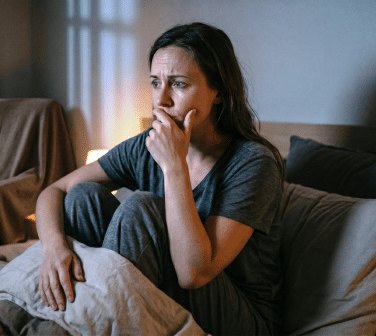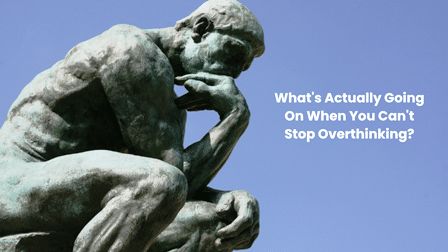

It should be easy. What to have for dinner. Whether to accept the invitation. Which email to answer first.
These are not life-changing decisions. You know that. And yet you have been staring at the options for twenty minutes and you still cannot choose.
Or maybe it is a bigger decision, a career move, a difficult conversation, something that actually matters, and the weight of it has brought everything to a standstill. You research. You make lists. You weigh the pros and cons. You ask people for their opinion. And still, nothing feels like the right answer.
Eventually, the deadline passes, or someone else decides for you, or you just do nothing and feel terrible about it afterwards.
If this is your experience, you are not indecisive. You are not bad at making decisions. Something else is going on, and it has less to do with the decision itself than with what your system is doing underneath it.
Here is something that does not get talked about enough.
Making a decision means tolerating uncertainty. Every choice involves a gap between what you know and what you do not know, between what you can control and what you cannot. You pick an option, live with the uncertainty of whether it was the right one, and move on.
For most people, most of the time, that gap is manageable. It does not feel comfortable, exactly, but it does not feel threatening either.
But when anxiety is running, that gap becomes a cliff.
Your system is already in a state of alert. It is already scanning for threats, already predicting that things could go wrong, already bracing for the worst. Adding uncertainty on top of that, even the small uncertainty of choosing between two restaurants, is like adding weight to a shelf that is already bowing.
The decision itself is not the problem. The problem is that your system does not have the spare capacity to absorb the uncertainty that comes with it.
When you cannot tolerate uncertainty, your brain tries to eliminate it. And the way it does that is by thinking harder.
You research more options. You run more scenarios. You compare, contrast, weigh, and analyse. You try to find the one choice that comes with a guarantee, the option where nothing can go wrong and no one will judge you and the outcome is certain.
That option does not exist. But your brain keeps searching for it anyway, because the anxiety is telling it that making the wrong choice is dangerous.
This is overthinking applied to a specific decision point. The same loop, the same scanning, the same inability to resolve, just focused on a particular choice.
And the longer you stay in the loop, the harder the decision feels. Because now you are not just deciding between two options. You are also managing the anxiety about taking too long, the frustration of not being able to decide, the worry about what it means that something this simple is this hard, and the creeping fear that you are falling behind while you sit there going back and forth.
What started as a simple choice has become a threat in its own right.
For many people, decision paralysis and perfectionism are closely linked.
If your system has learned that mistakes lead to bad outcomes, that getting things wrong means rejection, criticism, or failure, then every decision becomes a test you need to pass. There is no such thing as a low-stakes choice, because your internal filter treats all outcomes as potentially consequential.
Should I send the email now or wait? What if the timing is wrong? What if the tone sounds off? What if they take it the wrong way?
Each question adds another variable. Each variable adds more uncertainty. And the perfectionism, which looks like high standards on the surface, is actually a form of threat avoidance, an attempt to control every outcome so that nothing can go wrong.
This is a pattern I see frequently in high-functioning anxiety. The person appears capable, thorough, and detail-oriented. But underneath, the decision-making process is agonising. Simple tasks take far longer than they should because every step involves an internal risk assessment that the situation does not warrant.
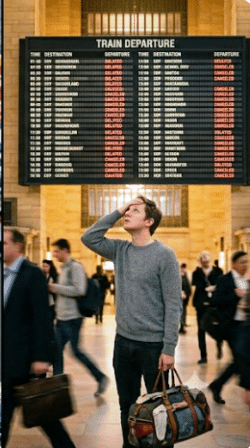
For some people, the pattern stays at the level of slowness and frustration. Decisions take longer than they should, but they get made eventually.
For others, the paralysis becomes total. The accumulation of unmade decisions builds into a backlog that feels insurmountable. Emails go unanswered. Opportunities pass. Life starts to narrow, not because of a conscious choice to withdraw, but because the inability to decide has the same practical effect as choosing to do nothing.
This is where the pattern connects to low-functioning anxiety and the freeze response.
The system, overwhelmed by the volume of perceived threats, stops processing them altogether. The paralysis is not laziness. It is a nervous system that has hit capacity and pulled the handbrake.
If you have experienced this, the frustration and shame can be intense. You can see the decisions piling up. You know they are not that hard. And you still cannot move.
Understanding that this is a nervous system response, not a character flaw, does not fix it instantly, but it does change the way you relate to it. And that is where the shift begins.
If decision paralysis is a regular part of your experience, the way forward is not to get better at making decisions. It is to address the state that is making decisions feel so dangerous in the first place.
In my one-to-one work with clients, coaching helps you identify the specific patterns that are driving the paralysis. What is your system actually afraid of when it stalls on a decision? Where did it learn that mistakes are that dangerous? What are the perfectionist filters, the avoidance cycles, the safety behaviours that are turning simple choices into threat assessments? Seeing these patterns clearly creates room to start responding to decisions differently, not by forcing yourself to choose faster, but by changing what the choice represents to your system.
Clinical hypnotherapy works with the deeper layer. It helps settle the baseline state of alert that makes every decision feel loaded. It works with the nervous system's tolerance for uncertainty, supporting your system in learning that not every outcome needs to be predicted, that imperfect decisions are survivable, and that it is safe to act without a guarantee.
Together, they address the pattern from both sides. Coaching works with the filters and behaviours you can observe. Hypnotherapy works with the nervous system responses that fire before you have a chance to observe them. The decision paralysis lives in the gap between the two, and that is exactly where the work is most effective.
You do not have to decide everything today.
If you have read this far and you are already weighing up whether to book a consultation, noticing the familiar pull of "but is it the right time, should I wait, what if it is not the right fit," that is the pattern doing its thing.
Here is what might help. You are not committing to anything. A 30-minute consultation is a conversation, not a contract. It is a chance to talk through what has been happening, ask questions, and get a clearer sense of whether this approach feels right. Available via Zoom. No preparation needed.
You do not need to be certain before you take the step. Certainty is what the anxiety is demanding, and it is the one thing a decision can never give you.
Sometimes the best decision is simply the next one.
This is the fifth post in an ongoing series exploring the specific ways anxiety shows up in daily life. The next post looks at what happens when anxiety makes you pull away from people, and why withdrawal feels like self-protection but often makes things worse.
Important Information: This blog post is for general informational purposes only. It does not constitute medical advice, diagnosis, or treatment. If you are experiencing persistent anxiety or have concerns about your mental health, please consult your registered health practitioner. Persistent fatigue can have medical causes unrelated to anxiety, and it is important to discuss ongoing exhaustion with your GP to rule out other conditions. If you are experiencing a mental health crisis or have urgent concerns about your safety, contact your GP or local emergency services immediately.

Tony Yuile is a Wellington-based Life Coach and Clinical Hypnotherapist dedicated to helping individuals navigate the complexities of anxiety and stress. Tony’s mission is driven by the belief that everyone deserves to feel in control of their own mental well-being. He specialises in providing practical, mind-based tools that empower his clients to manage anxiety and stress effectively and rediscover a sense of calm and confidence in their daily lives.