
If you have been living with anxiety for a while, you have probably noticed something.
It is not just in your head. It is in your chest. Your stomach. Your shoulders. It is in the way you avoid certain situations, the way you over-prepare for others, and the way your mind keeps running even when you are exhausted and desperately want it to stop.
Anxiety is not a single thing.
It is not just a worried thought you can catch and correct. And if you have ever been told to "just stop overthinking" and found that advice completely useless, there is a good reason for that.
One of the most common ways anxiety gets explained is through the idea that your thinking drives how you feel. Change the thought, change the feeling. And there is some truth in that — but it is only part of the picture.
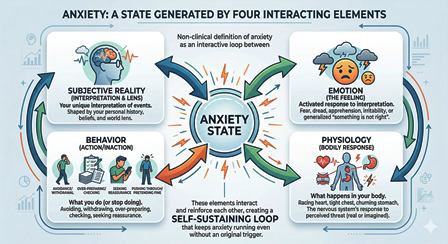
In my work with clients, I use a different framework. I see anxiety as a state of being: something your whole system generates through the interaction of four things:
What you feel emotionally: the fear, the dread, the apprehension, the irritability. Sometimes a clear emotion you can name. Sometimes just a background hum of unease that will not lift.
What happens in your body: the racing heart, the tight chest, the nausea, the restlessness, the exhaustion. Your nervous system does not wait for your conscious mind to assess a situation. It responds to what it predicts is coming, based on everything it has learned so far.
What you do: the avoiding, the withdrawing, the over-preparing, the checking, the pushing through while pretending everything is fine. Or, when anxiety becomes overwhelming, the shutting down altogether.
These four things do not just happen alongside each other. They feed into each other. They reinforce each other. And when they get locked into a repeating pattern, anxiety stops being a response to a specific situation and starts becoming the state you are living in.
If anxiety were simply a thinking problem, changing your thoughts would fix it. For some people, in some situations, that does help. But if you have tried that and found that the anxiety keeps coming back, or that you understand perfectly well that your worry is irrational and it makes no difference, it is probably because the pattern runs deeper than conscious thought.
Your body is reacting before your mind has caught up. Your system is making predictions based on past experience and generating a felt sense of threat that arrives in your awareness already fully formed. By the time you notice you are anxious, the whole state is already in motion.
This is not a flaw. It is your survival system doing what it was designed to do. The difficulty is that sometimes it gets stuck, running threat detection in situations where it is no longer needed, keeping your body in a state of readiness for danger that is not actually there.
Understanding anxiety this way changes what effective support looks like.
Rather than just working with your conscious thoughts, it means working with the whole pattern, the way you experience and interpret the world, the emotional and physical responses that fire automatically, and the behaviours that keep the cycle running.
That is the approach I take in my one-to-one coaching and clinical hypnotherapy work with adults experiencing anxiety. Coaching helps you see and shift the parts of the pattern you can access through reflection and awareness. Clinical hypnotherapy works with the deeper levels, the automatic responses, the ingrained predictions, the survival patterns that conscious effort alone may not reach.
If anxiety has become the state you are living in rather than an occasional visitor, this is a different way to think about what is going on — and what might actually help.
This is the first in a short series of posts exploring how anxiety works and why some approaches to managing it are more effective than others. The next post looks at why your experience of the world is not the same as your thinking, and why that distinction matters more than you might expect.
If you would like to talk through what you have been experiencing, book a 30-minute consultation
Important Information: This blog post is for general informational purposes only. It does not constitute medical advice, diagnosis, or treatment. If you are experiencing persistent anxiety or have concerns about your mental health, please consult your registered health practitioner. If you are experiencing a mental health crisis or have urgent concerns about your safety, contact your GP or local emergency services immediately.

Tony Yuile is a Wellington-based Life Coach and Clinical Hypnotherapist dedicated to helping individuals navigate the complexities of anxiety and stress. Tony’s mission is driven by the belief that everyone deserves to feel in control of their own mental well-being. He specialises in providing practical, mind-based tools that empower his clients to manage anxiety and stress effectively and rediscover a sense of calm and confidence in their daily lives.