
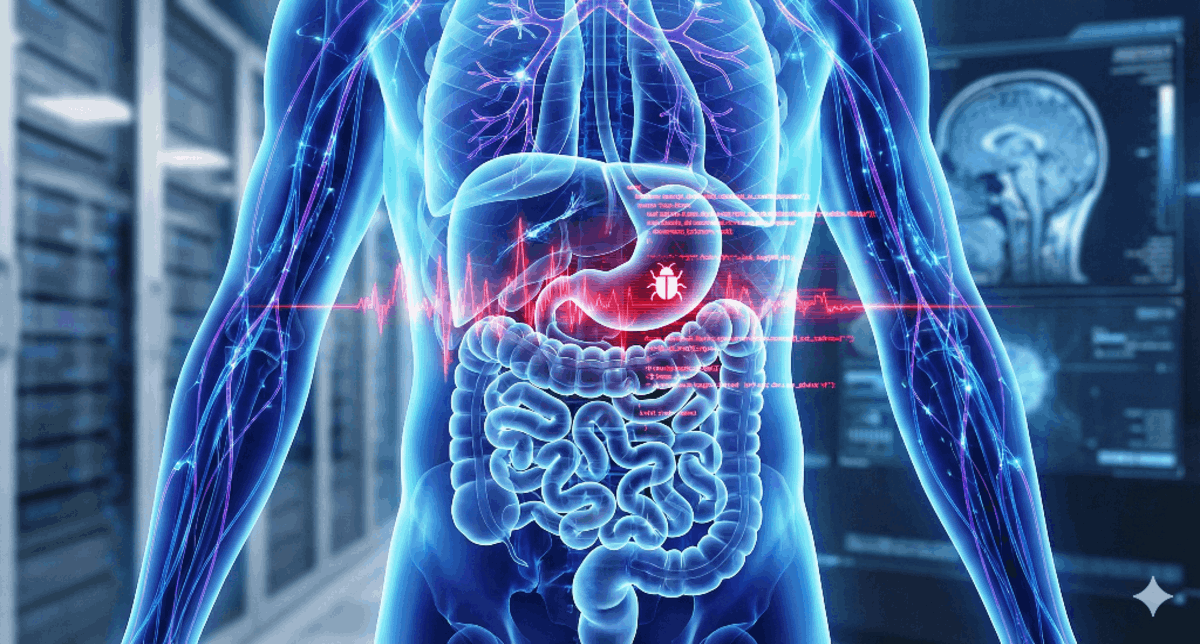
IBS isn’t a hardware problem. It’s a software problem.
Yes, a software problem. Let me explain.
If you have IBS and have been told: “Your tests are normal. It’s just IBS.”
You’re not alone.
This article reframes IBS as a gut–brain signalling issue, not a broken gut, and walks through why nervous system regulation matters when diet changes are not enough.
When a health professional says, “It’s just IBS” what people often hear is:
“So there’s nothing wrong.”
But you’re living with pain, bloating, urgency, constipation, diarrhoea (or both), and a gut that can hijack meetings, travel, and even a simple commute.
So we need to clarify this properly.
IBS is not a hardware problem
For most people with IBS, the digestive “hardware” looks structurally healthy on common tests. No ulcers. No tumours. No visible tissue damage.
IBS is a functional condition, now described as a Disorder of Gut–Brain Interaction.
Meaning: the hardware is intact, but the gut–brain communication “software” is running an unhelpful program.
The gut–brain “software”
Your brain and gut are in constant two-way communication through:
- The autonomic nervous system (ANS)
- The vagus nerve
- Hormonal signalling (including the HPA axis)
- Immune pathways
- Microbiota signalling
When this system is regulated, digestion is usually smooth and predictable.
When it is dysregulated, a few things can shift:
- Motility speeds up or slows down
- Sensitivity increases (normal sensations start to feel painful)
- Pain thresholds drop
- The gut becomes more reactive
No structural damage.
But faulty signalling.
Like perfectly good hardware running glitchy code.
Where “stress” actually fits (and why definitions matter)
Most people are told: “Manage your stress.”
But the word “stress” gets used so loosely that it becomes useless.
Here’s the cleaner model I use.
A stressor is anything that activates your autonomic nervous system because it is perceived as a demand or a threat.
- If the demand feels manageable, you tend to experience pressure.
- If the demand feels threatening, your survival response activates and you experience stress (a felt state that comes from that activation).
And two more that matter in IBS:
- Worry is the mental process of imagining future risks.
- Anxiety is the body state that often comes from that anticipation.
Why does this matter?
Because IBS often becomes a symptom–threat loop:
Symptoms → perceived threat → survival activation → more symptoms.
Over time, repeated survival activation can contribute to:
- Visceral hypersensitivity (the gut feels “too loud”)
- Altered motility
- Amplified pain processing
- Hypervigilance toward symptoms
This is a big reason IBS is often described as “stress-sensitive”. Not imagined. Not exaggerated. Just deeply intertwined with nervous system regulation.
Why diet and lifestyle changes alone can feel like a dead end
Diet and lifestyle matter, and they can be genuinely helpful.
But if the nervous system remains on high alert, you can end up adjusting inputs while the operating system stays dysregulated.
That’s when high-functioning professionals tell me:
“I’m doing everything right… and I’m still stuck.”
Not because you are failing.
Because the software has not changed yet.
The shift that changes the whole plan
When we treat IBS as a software issue, the approach changes.
We focus on skills that help the system feel safer and become more predictable again:
- Improving autonomic regulation (more rest-and-digest capacity)
- Reducing perceived threat around symptoms and situations
- Calming gut–brain signalling
- Retraining patterns that reinforce hypervigilance and avoidance
This is the foundation of the work I do inside my Freedom IBS Program.
Not as a promise of perfection.
As a practical, structured way to stabilise the system that’s generating the symptoms, so your gut stops calling the shots as often.
A question for you
If IBS hijacks your professional life, what situation is the worst?
High-stakes meetings?
Presentations?
Travel days?
Client lunches?
The commute?
